



Reverse no longer visible
In March 1918, World War I entered a new phase when the Germans began bombing Paris. The art dealer Léopold Zborowski (1889–1932) made the arrangements for a small group, including Modigliani, Jeanne Hébuterne (1898–1920), and Chaim Soutine (1893–1943), to relocate to the South of France. By April, the group had settled in Cagnes-sur-Mer and in July they moved to Nice. While in the Midi region, due to a dearth of models, Modigliani often painted local townspeople, servants, and children.
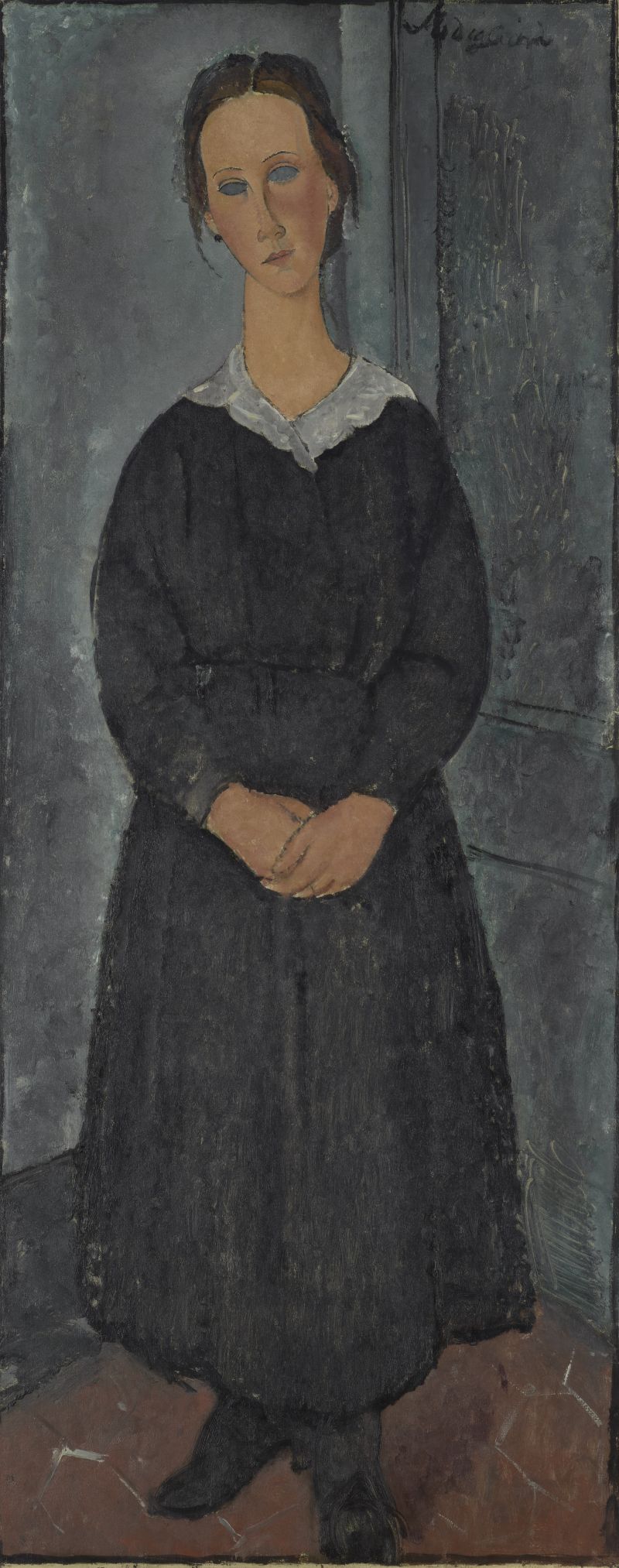
The model for this painting has been identified as Marie Féret, who was "a peasant girl from Cagnes" who is believed to have also served as Modigliani's model for Girl in a Sailor's Blouse (AMDC 34).1 While her name has remarkably been preserved, Féret's identity has not yet been confirmed, but her role as a maid is certain. Nonetheless, Modigliani portrayed her with stature; she stands at full height and the canvas is nearly life-sized. La Jeune bonne is one of only two paintings in his oeuvre to portray the model from head to toe. The other painting, Ceroni 245, depicts a young girl standing in a corner, similar to how the servant girl is posed here.
While the early provenance of the painting is unclear, Pierre Bertin (1891–1984) is on record as one of the first owners.2 An actor and a writer, Bertin helped organize the 1916 Lyre et Palette exhibition in Paris in which Modigliani's paintings were prominently featured. In 1917, Bertin married Marcelle Meyer (1897–1958), the sister of Germaine Meyer (dates unknown); Germaine sat for two portraits by Modigliani in Nice in 1918 (Ceroni 276 and 277). There is a possibility that Bertin acquired La jeune bonne directly from the artist at that time.
Canvas information
This work has a frame-like painted border around the composition, a common feature found in several of the artist’s paintings, which is typically but not consistently black. This device was likely used for the sizing of the canvas in the absence of a wooden strainer.3
- Arthur Pfannstiel, Modigliani: catalogue présumé (Paris: Éditions Marcel Seheur, 1929), 39, as La servante (Marie Feret, paysanne de Cagnes). Contradicting this information, however, a photograph of the painting in the Bignou archives noted that the model was a woman named Louise Dermet. Information about Dermet has not yet been located. Amedeo Modigliani, La Jeune Bonne, c. 1918. Bignou Etienne, ODO 1996–29, XVII Modiliani [sic]–Redon, 15. Musée d'Orsay Archives, Paris.
- Ibid.
- For more on the artist's use of painted frames, see Annette King, Nancy Ireson, Simonetta Fraquelli, and Joyce H. Townsend, "An Introduction to Modigliani's Materials and Techniques," The Burlington Magazine CLX (March 2018): 186.