



Reverse not inscribed
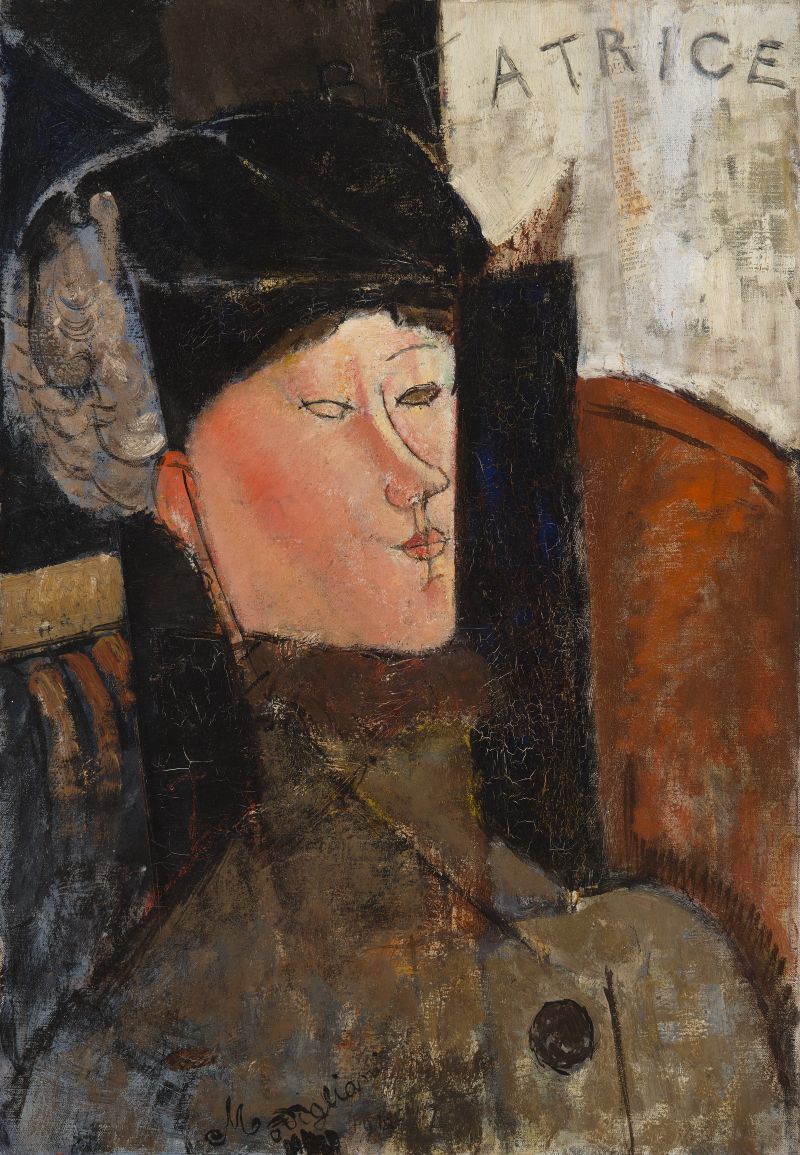
Beatrice Hastings was the pen name of Emily Alice Haigh (1879–1943), the English poet and writer. She was an established journalist in London, writing for The New Age, which focused on art and politics.1 In 1914 she moved to Paris as the journal's correspondent and met Modigliani soon after her arrival. The two were romantically linked for approximately two years, and while their relationship was volatile—fueled by drugs and alcohol—it nevertheless provided a fertile ground for the artist's transition from sculpture to painting.2 Beatrice served as his model for numerous portraits, the stylistic range of which reveals his artistic experimentation from Pointillism to Cubism, including this portrait that incorporated newspaper collage.
Two photographs that were likely taken by Modigliani and the art dealer Paul Guillaume (1891–1934) around 1916 show each man sitting in turn in a chair in the artist's studio at 13, rue Ravignan, where this portrait of Beatrice Hastings can be seen hanging on the wall behind them.3 These photographs offer rare lifetime documentation of a work by the artist.
This may have been the portrait of Hastings that Guillaume included in the November 1916 Lyre et Palette exhibition, where it was titled Portrait de la Poetesse H, and possibly also the painting shown at Guillaume's gallery in December 1918, when it was simply titled Beatrice.4
When it was shown at Galerie Bernheim-Jeune in Paris in 1922, it was listed as "Au Théatre, Béatrice."5 Hastings's elegant attire and the indication of what appears to be an upholstered banquette and a rust-colored velvet panel behind her at right indeed suggest the setting of a theater. This theory is further supported by the inclusion of a collaged newspaper clipping, which is visible in the 1916 photograph of the work, and has been identified as a listing of theatrical performances published in Le Monde on February 15, 1916.6
Dr. Albert C. Barnes (1872–1951) purchased his first Modigliani works in August 1922, buying two small drawings from Guillaume.7 By July of the following year, he had acquired nine paintings and a stone head, making him the most significant collector of the artist's work in the United States at that time. Today, the Barnes Foundation owns twelve paintings, which makes it one of the largest public Modigliani collection in the world.8
Canvas information
Technical analysis of the painting revealed that the canvas appears to have been reused, although the original composition and artist are unknown.9 The painting's ground color was identified as white in the 2022 exhibition catalogue for Modigliani Up Close.10
For more on the 1916 and 1918 exhibitions see the essays published in Spotlight: “Première Exposition,” Lyre et Palette and "Peintres d'aujourd'hui."
- Barbara Buckley and Simonetta Fraquelli, "Beatrice," in Barbara Buckley, Simonetta Fraquelli, Nancy Ireson, and Annette King, eds., Modigliani Up Close. Exh. cat. (Philadelphia: The Barnes Foundation, 2022), 64.
- Kathleen Brunner, "Biographies of Modigliani's Models: Beatrice Hastings," in Simonetta Fraquelli and Norman Rosenthal, eds., Modigliani and his Models. Exh. cat. (London: The Royal Academy of Arts, 2006), 150.
- The photographs are in the collection of the Musée de l'Orangerie, Paris and are reproduced in Simonetta Fraquelli and Cécile Girardeau, eds. Modigliani: A Painter and His Art Dealer. Exh. cat. (Paris: Musée de l'Orangerie with Flammarion, 2023), Front portfolio, figs. 1 and 5.
- At this time, Guillaume is known to have owned a second portrait of Hastings (Ceroni 109), which is also a possibility, however, only the portrait at the Barnes Foundation is inscribed with her name.
- Galerie Bernheim-Jeune, Paris, Modigliani. Exh. cat. (February 7–21, 1922), no. 21.
- Barbara Buckley and Simonetta Fraquelli, "Beatrice," in Barbara Buckley, Simonetta Fraquelli, Nancy Ireson, and Annette King, eds., Modigliani Up Close. Exh. cat. (Philadelphia: The Barnes Foundation, 2022), 64. This is the only known Modigliani painting that incorporates newspaper clippings. Pablo Picasso, Georges Braque, and Juan Gris incorporated newspaper into their Cubist collages between 1912 and 1914.
- The drawings are: Raimondo, 1915, 8 7/16 x 5 1/16 in. (21.4 x 12.9 cm; BF634) and BAIRON, 1915, 7 x 4 in. (17.8 x 10.2 cm; BF635).
- The Chester Dale Collection at the National Gallery of Art in Washington, D.C., also has twelve paintings, one of which is not included in Ceroni's 1970 catalogue.
- Buckley and Fraquelli (2022), op. cit, 66.
- Ibid.
- Barnes Foundation (BF361) (collection.barnesfoundation.org)