
Artwork
Reverse not inscribed
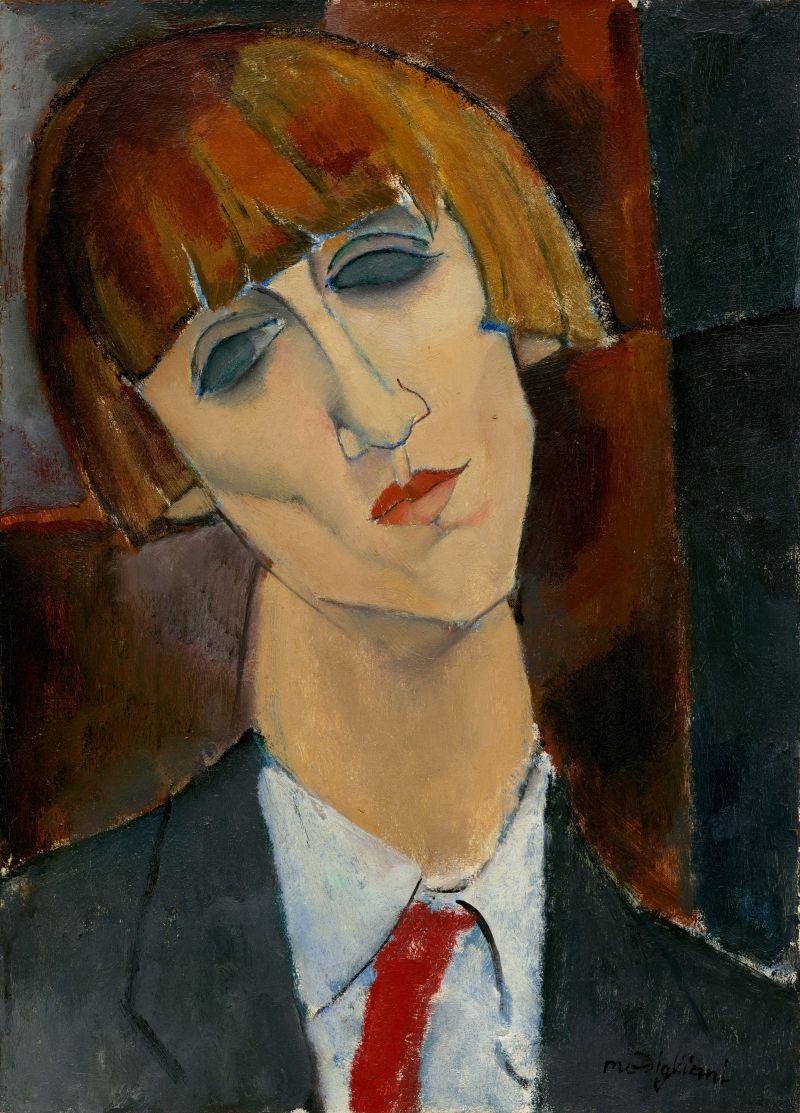
Though historically known as Madame Kisling, the painting was likely titled René-Jean when it was shown in the 1916 exhibition at Lyre et Palette. Born Renée Marie Anne Gros (1894–1960), the model of this painting insisted on calling herself René-Jean and was known as such in Montparnasse's cultural circle.1 She was an avant-garde style icon, dressing in men's clothing and sporting a short, masculine-looking bob, years before this type of hairstyle became popularly known as "La Garçonne," following Victor Margueritte's 1922 novel of the same title.2
Gros met Modigliani's friend and fellow painter Moïse Kisling (1891–1953) in 1916 and became Madame Kisling when she married him on August 12, 1917. Together, they formed a striking couple, often dressing in matching cowboy shirts and attracting attention with their matching hairstyles.3 Modigliani painted a second portrait of Renée (Ceroni 163) and three portraits of Moïse (Ceroni 98, 107, and 154).
The presumed inclusion of Madame Kisling in the exhibition at Lyre et Palette, suggests a 1916 dating of the work.
Canvas information
Technical analysis of the painting revealed that beneath Madame Kisling is a landscape; the painter of this has not been identified.4
For more on the 1916 exhibition and Renée Gros Kisling, see the essay published in Spotlight: “Première Exposition,” Lyre et Palette.
- Émile Lejeune, “Montparnasse à l’Epoque Héroique: Un peintre genevois réunit dans son atelier les chefs de file de la nouvelle peinture,” Tribune de Genève (February 8, 1964), 1. https://www.e-newspaperarchives.ch/?a=d&d=TDG19640208-01.2.2
- Victor Margueritte, La Garçonne (Paris: Ernest Flammarion, 1922).
- Crespelle (1962), op. cit.
- Alice Craigie, National Gallery of Art, email of December 6, 2023.
- National Gallery of Art (1963.10.175) (https://www.nga.gov/artworks/46650-madame-kisling)