
Artwork
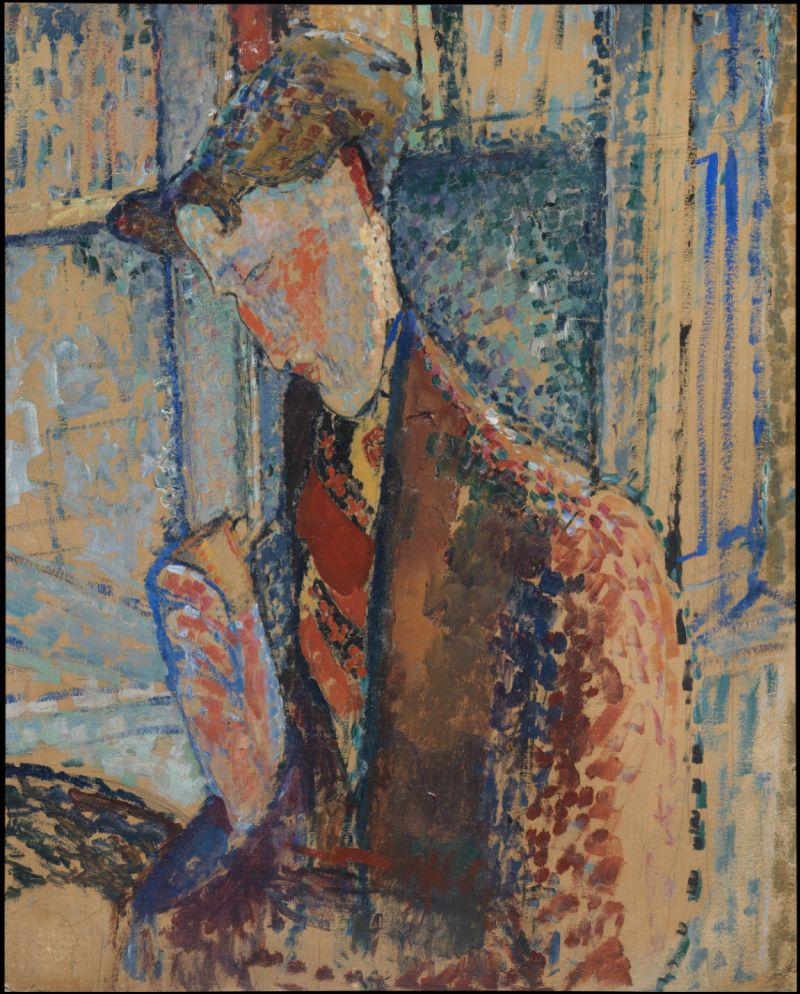
It was in 1914 in the studio of Frank Burty Haviland (1886–1971) where Modigliani resumed painting after having worked as a sculptor for several years.1 According to Adolphe Basler (1878–1951), the Polish-born art critic, Burty Haviland loaned Modigliani the necessary supplies and it seems plausible that Reverie, which has a figure study by Burty Haviland on the reverse, may have been one of Modigliani's first paintings. A member of the Haviland family, the well-known makers of porcelain, Frank Burty Haviland collected the artwork of his friends, including Juan Gris (1887–1927) and Pablo Picasso (1881–1973).2 He also had an exceptional collection of African art and, as Basler reports, his studio was where Modigliani became inspired by the unique forms of these objects.3 Modigliani painted a second portrait of Burty Haviland, which is also on cardboard (Ceroni 44).
- Adolphe Basler, "Amadeo [sic] Modigliani," Le Crapouillot (August 1927): 14.
- Anna Jozefacka, "Frank Burty Haviland (also Frank Haviland and Frank Burty)," The Modern Art Index Project (July 2017), Leonard A. Lauder Research Center for Modern Art, The Metropolitan Museum of Art. https://doi.org/10.57011/MLMO4009
- Basler (1927), op. cit.
- Los Angeles County Museum of Art (27.7.2a) (https://collections.lacma.org/node/228330)